Leuchars Paris 2 Rue de la Paix Paris
Leuchars Paris
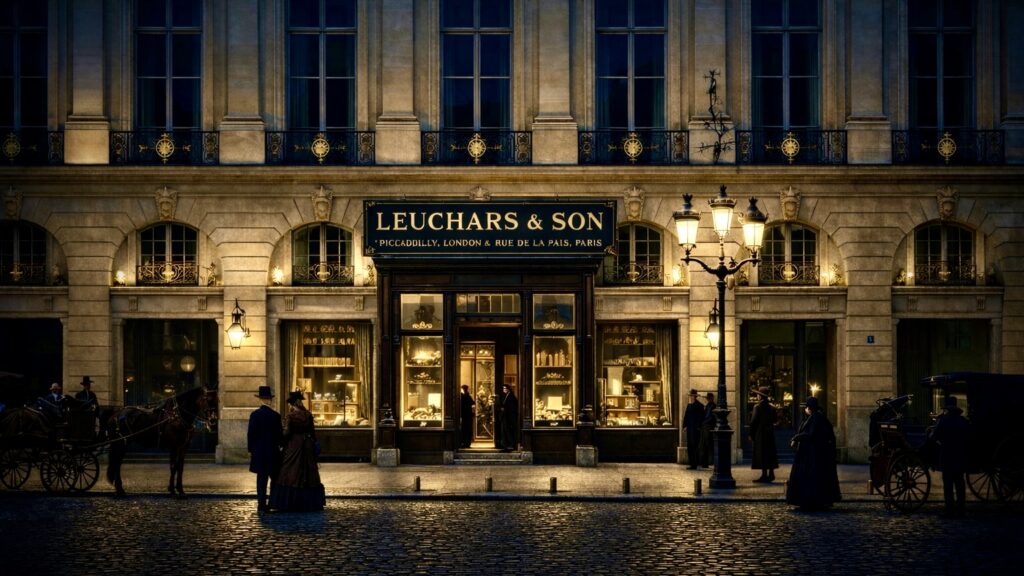
Leuchars Paris forms one of the most important chapters in the history of the house. More than a passing continental address, it reflects a sustained presence at 2 Rue de la Paix, Paris, one of the most prestigious luxury streets in Europe. The surviving evidence shows that Leuchars operated as a London–Paris house, presenting itself across both capitals through its printed documents, exhibition records and the objects it sold.
This page brings together the strongest evidence currently identified for the Paris operation and sets out the most accurate account presently possible. It is designed as a working archive reference: clear about what is confirmed, careful about what is probable, and explicit about what remains unresolved.
Overview
The present evidence confirms that Leuchars & Son was operating from 2 Rue de la Paix, Paris by 1 March 1877. A dated billhead from that day records the firm at 38–39 Piccadilly, London and adds “Also at 2 Rue de la Paix, Paris”. By 1878, Leuchars was officially exhibiting as a London–Paris house, with both addresses listed in the British section catalogue for the Paris Exposition.
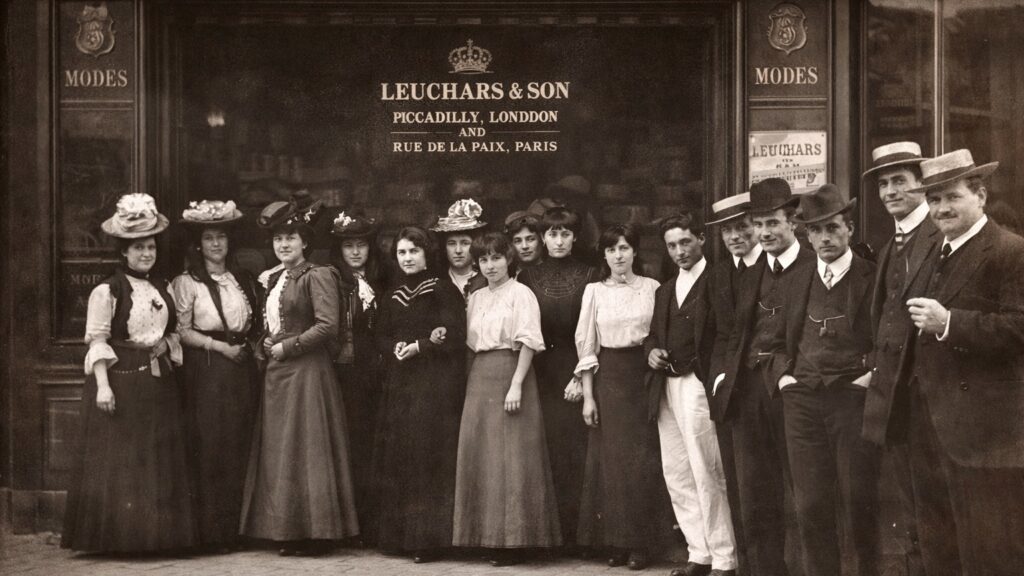
The evidence also shows that the Paris operation continued well beyond the nineteenth century. Surviving invoices described as dating from 1894 and 1921 both identify Leuchars at 2 Rue de la Paix, while a surviving postcard photograph shows staff outside the Paris premises in the early twentieth century. Objects on the antiques market also preserve the Paris identity in stamped, printed and gilt interior markings.
What Is Confirmed
Confirmed: Leuchars was operating at 2 Rue de la Paix, Paris by 1 March 1877, as shown by a dated billhead carrying both the Piccadilly and Paris addresses.
Confirmed: In 1878, Leuchars publicly described itself as a business based in both London and Paris. In the official British section catalogue for the Paris Exposition, the firm appears as “Leuchars & Son; 38 and 39, Piccadilly, London; and 2, Rue de la Paix, Paris”, offering dressing cases, travelling bags, gold and silver work, and leather work of all descriptions.
Confirmed: The Paris operation remained active into the late nineteenth and early twentieth centuries. Surviving invoices attributed to 1894 and 1921 both retain the Rue de la Paix address, while a postcard showing Leuchars staff in front of the Paris premises supports continued operation in the early 1900s.
Confirmed: Surviving objects preserve a dual London–Paris identity. Cases and related luxury goods are known bearing inscriptions linking 38–39 Piccadilly, London with 2 Rue de la Paix, Paris, demonstrating that the Paris address formed part of the firm’s public and commercial identity.
What Is Probable
Probable: The Paris operation may have begun in 1870. This date appears in later summaries and antique-market references and is consistent with the existence of a fully established Paris address by 1877. However, until a dated directory entry, advertisement, lease or comparable primary source is located from 1870 itself, this date should be treated as probable rather than fully proven.
Probable: Leuchars Paris functioned primarily as a retail and luxury-goods house rather than as a separate Paris manufacturing workshop. The exhibition record, surviving invoices and the object evidence all suggest a business selling and presenting finished dressing cases, travelling goods, stationery, leather goods and precious-metal objects. Some goods were likely made in Britain and sold through Paris; others may have been sourced, fitted or finished for the Paris market.
Probable: The later Paris business had a successor relationship with Maison Geffroy. This is strongly suggested by invoice descriptions stating that the house had succeeded the Geffroy business and by surviving signed objects using forms such as “Leuchars & Son Geffroy Succ.” What remains uncertain is the exact legal and commercial structure of that relationship.
What Remains Unresolved
Unresolved: The exact opening date of Leuchars Paris remains unproven at primary-source level.
Unresolved: The precise business structure of the Paris operation is not yet fully established. It is not yet possible to state with certainty whether the Paris house was a direct London branch, a successor business under local ownership, a partnership structure, or a hybrid retail arrangement.
Unresolved: The exact legal significance of the Geffroy successor wording remains to be confirmed from French trade directories or commercial registers.
Unresolved: The frequently repeated claim that Leuchars received a gold medal at the 1878 Paris Exposition is strongly associated with the firm in later commercial material, but the exact official award record still needs to be identified and cited directly.
Unresolved: The final closure date of the Paris operation after 1921 has not yet been firmly established.
Chronological Timeline
By 1 March 1877
Leuchars & Son is definitely operating from 2 Rue de la Paix, Paris. A dated billhead records the London address at 38–39 Piccadilly and adds “Also at 2 Rue de la Paix, Paris.”
1878
Leuchars appears in the official British section catalogue for the Paris Exposition as a London–Paris house with addresses at 38 and 39 Piccadilly, London and 2 Rue de la Paix, Paris. Its listed trade includes dressing cases, travelling bags, gold and silver work, and leather work.
Late 19th Century
Surviving objects and cases continue to appear with dual London–Paris identity, showing that the Rue de la Paix address was used not only in paperwork but on finished goods and fitted interiors.
1894
A surviving Paris invoice attributed to this year records Leuchars at 2 Rue de la Paix and associates the house with a successor relationship to Maison Geffroy.
c.1905–1910
A postcard photograph shows Leuchars staff standing outside the shop at 2 Rue de la Paix, Paris, indicating continued public trading presence in the early twentieth century.
1921
A further surviving invoice shows Leuchars still trading from 2 Rue de la Paix, confirming that the Paris house remained active at least into the early 1920s.
Rue de la Paix and the Importance of Location
The Paris address matters because Rue de la Paix was one of the great luxury streets of Europe. Its importance was not merely local or fashionable; it was structural to the luxury economy of Paris. To trade from Rue de la Paix was to place a house within an elite commercial environment tied to jewellery, silver, leather goods, presentation objects, travel culture and high society consumption.
Leuchars Paris therefore should not be understood as a peripheral outpost. It was a presence in a prestigious Parisian luxury district, operating in a setting that later became synonymous with the highest levels of international luxury retail. This elevates the significance of every surviving object, invoice and label bearing the Rue de la Paix address.
How Leuchars Paris Appears on Surviving Objects
The Paris operation survives not only in paper records but in objects themselves. These markings are especially important because they preserve how the business presented its identity to customers. Known forms include:
- Leuchars Paris
- Leuchars & Son Paris
- 38–39 Piccadilly, London and 2 Rue de la Paix, Paris
- Leuchars & Son Geffroy Succ.
These inscriptions may appear in different forms depending on the object: gilt toolings to leather interiors, silk linings, retailer stamps, paper labels, invoice headings or internal case fittings. Taken together, they show that Paris was embedded in the working identity of the house rather than added retrospectively by later sellers or commentators.
What Leuchars Paris Sold
The strongest documentary evidence indicates that Leuchars Paris sold a range centred on dressing cases, travelling bags, gold and silver work, stationery and leather goods. This aligns closely with the wider Leuchars identity as a house concerned with travel, order, presentation and finely fitted luxury objects.
The Paris business appears to have been broader than a single-product specialist. It should instead be understood as a luxury house retailing and presenting a family of related goods: cases, fitted accessories, refined travel objects, writing equipment and precious-metal mounted personal items. This breadth is one of the clearest signs that Leuchars Paris operated at a serious level rather than as a token foreign address.
Business Structure: Best Current Reading
On the current evidence, the most plausible interpretation is that Leuchars Paris operated as a luxury retail branch or successor-form house tied to the London business, with increasing local distinctiveness over time. The dual-address exhibition record strongly suggests a direct London–Paris identity in the late 1870s. The later Geffroy wording suggests that the Paris operation may subsequently have developed through succession, acquisition, partnership or reorganisation.
At present, the safest conclusion is that Leuchars Paris was commercially real, long-running and structurally significant, but not yet fully decoded in legal terms. Further French directory and register work is required before the exact ownership model can be stated with full confidence.
Leuchars Paris in the History of the House
Leuchars Paris matters because it changes the scale at which the house must be understood. The evidence does not describe a purely London maker with occasional foreign sales. Instead, it describes a business operating across two leading capitals of nineteenth-century taste, with a sustained Paris presence on one of Europe’s most prestigious luxury streets.
This London–Paris identity helps explain why Leuchars objects feel broader than mere utility. Their world is one of travel, silver, leather, presentation, order and cultivated personal use. The Paris chapter deepens that reading and supports the view of Leuchars as an international luxury house rather than a narrowly local trade name.
Research Status
This page reflects the strongest current evidence assembled for the Paris operation of Leuchars. It is intended as a rigorous archive summary rather than a closed final statement. As further primary material emerges, particularly Paris trade directories, commercial registers, advertisements and award records, this account can be refined further.
For now, the core conclusion is secure: Leuchars Paris was a genuine and important part of the house, operating from 2 Rue de la Paix by 1877 and still active in 1921, with a documented London–Paris identity expressed through exhibition records, invoices and surviving objects.
