
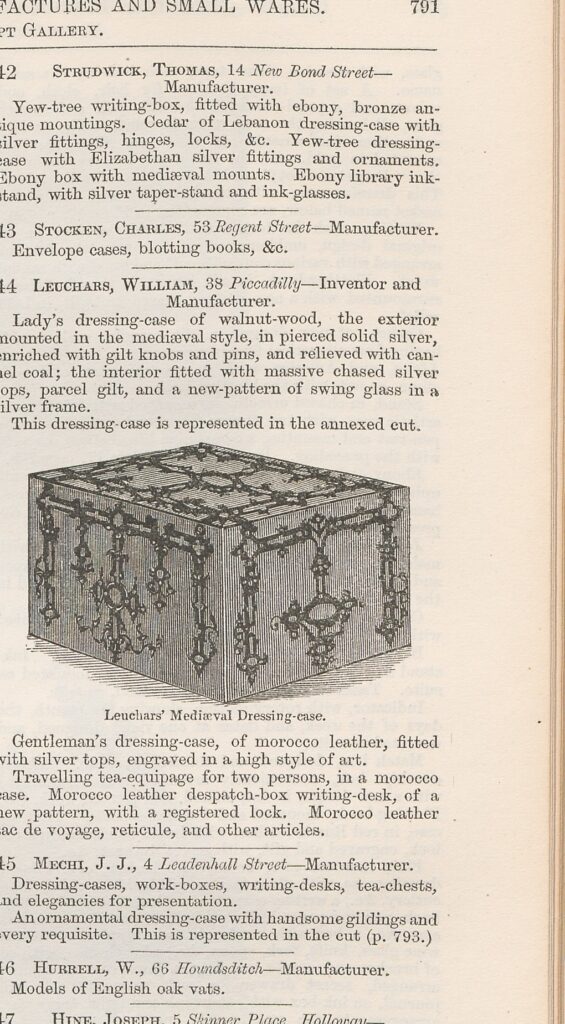
Archive Record 001
Object: Lady’s dressing case
Exhibitor: W. Leuchars, 38 Piccadilly, London
Date: 1851
Materials recorded: Walnut wood; pierced solid silver; chased silver and parcel gilt
Present location: Not established
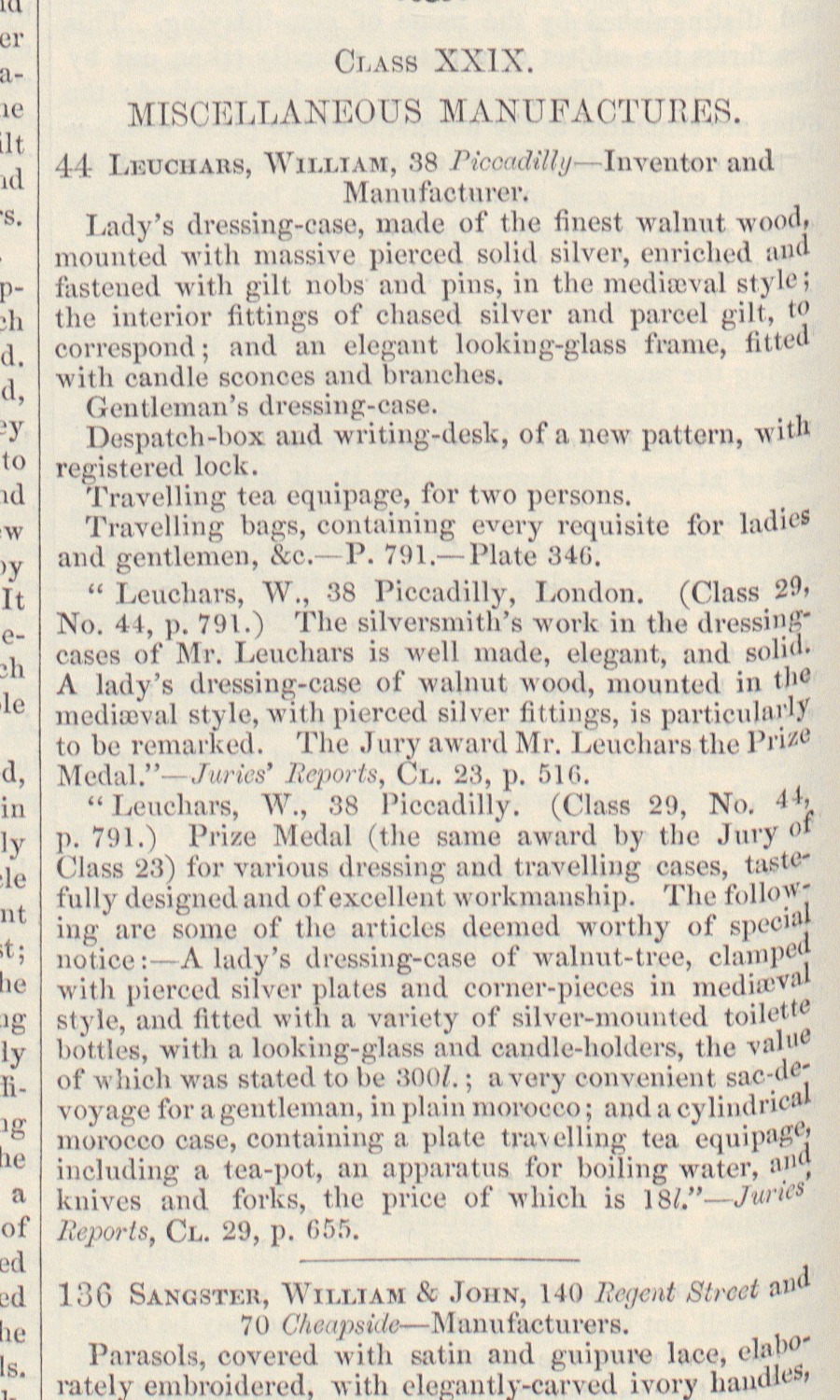
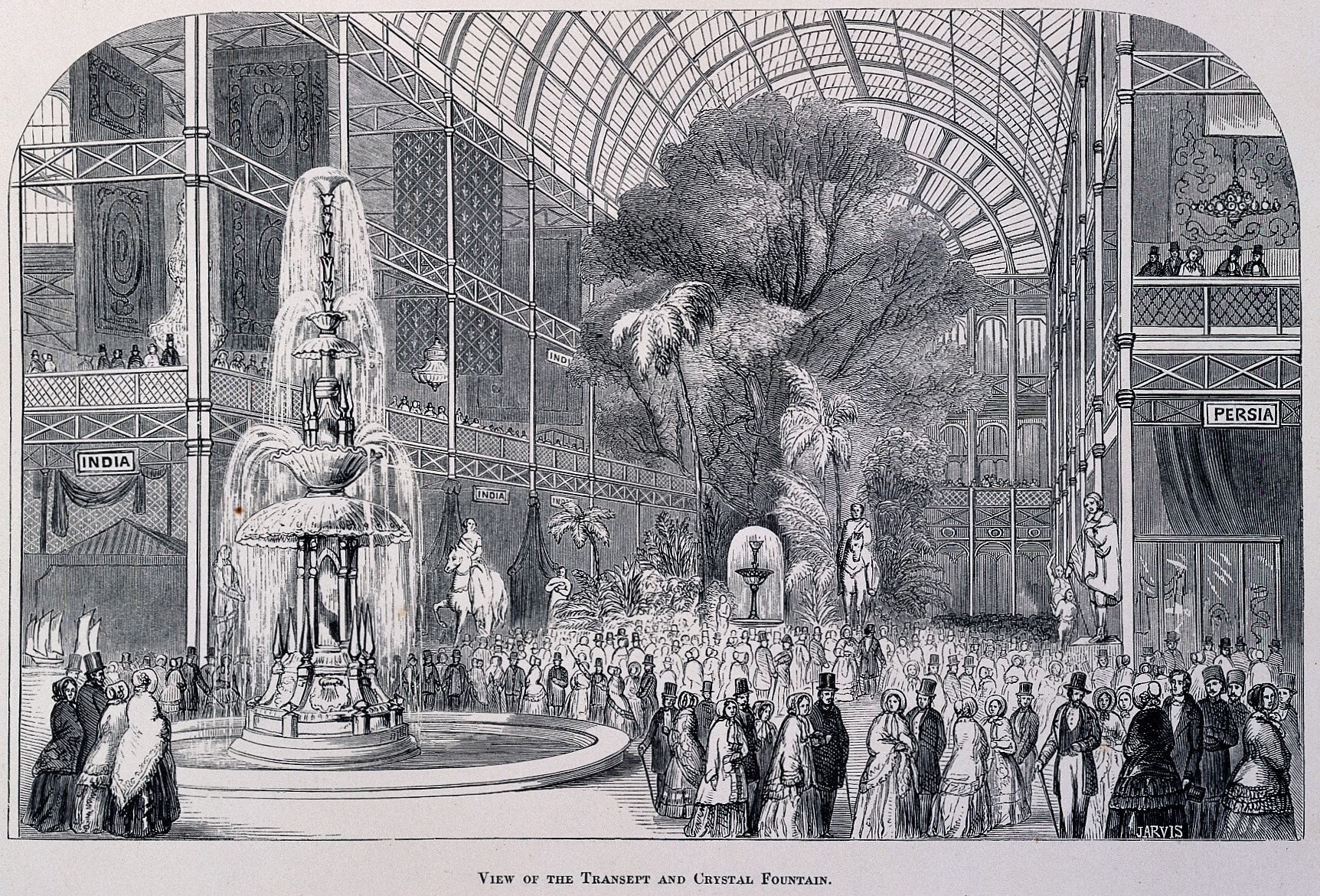
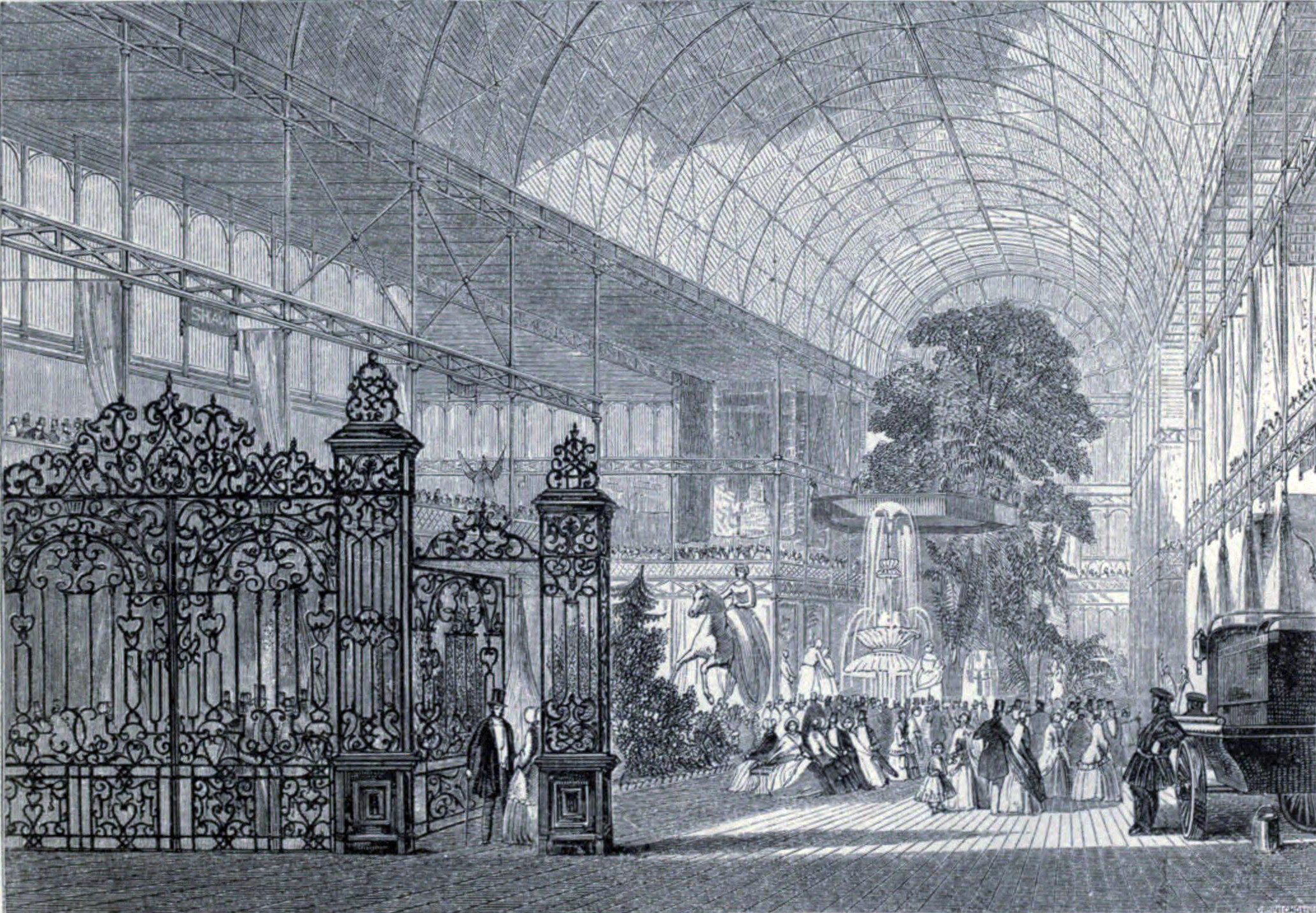
In 1851, the Great Exhibition brought manufacturers, designers and objects from Britain and abroad together beneath the glass and iron roof of the Crystal Palace in Hyde Park. The official catalogue records William Leuchars of 38 Piccadilly among its London exhibitors.
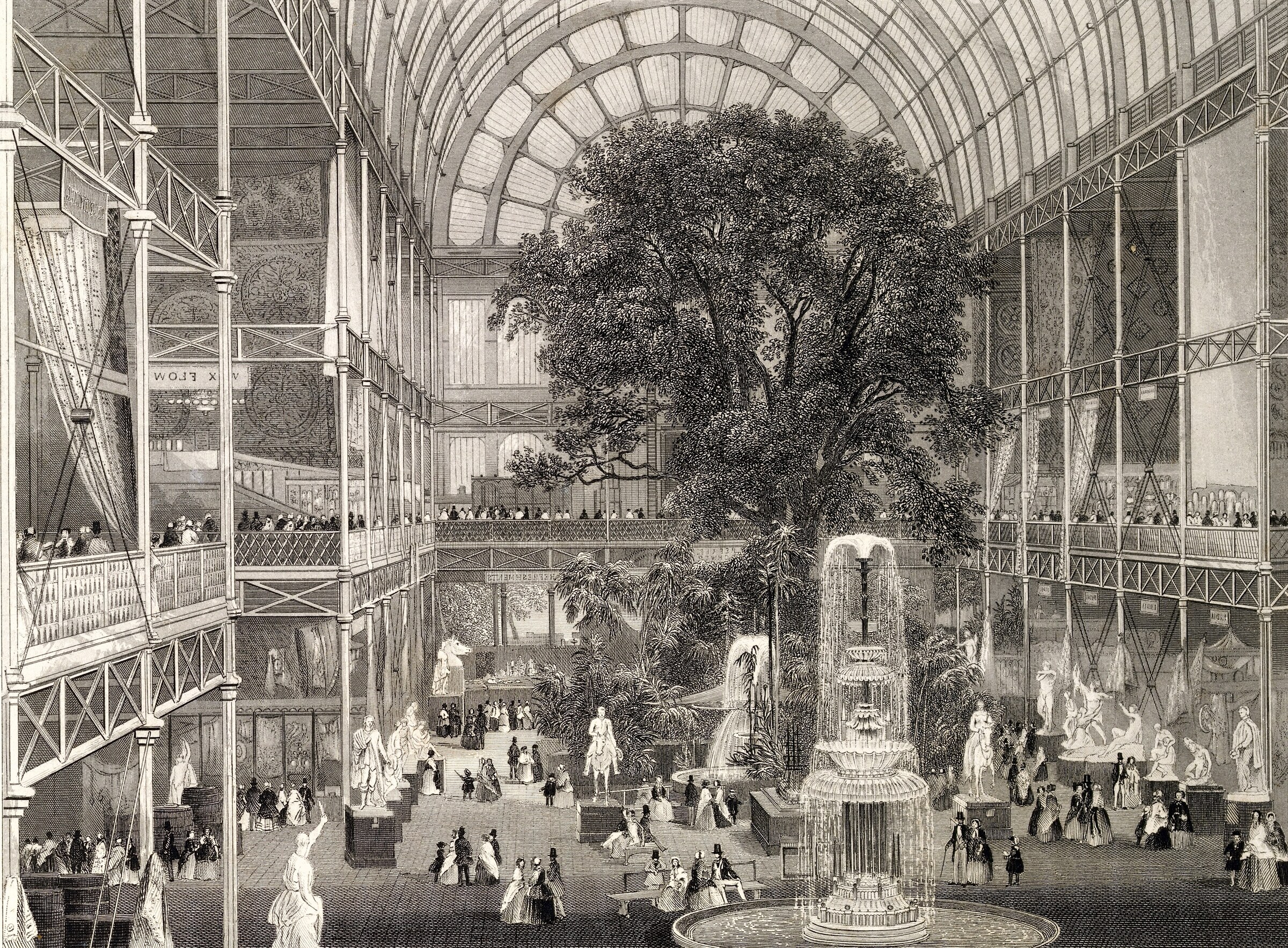
The Leuchars entry concerned a lady’s dressing case made in walnut wood and mounted in what the catalogue called the medieval style. Pierced solid-silver exterior work and chased silver and parcel-gilt interior fittings formed part of its decorative and functional scheme. A looking-glass frame was fitted with candle sconces and branches.
The exhibition jury drew particular attention to this walnut case when assessing the silver work shown in Leuchars dressing cases. Its report judged that work well made, elegant and solid and awarded W. Leuchars a Prize Medal. A contemporary catalogue summary gave the case’s stated value as £300.
The importance of the record lies not only in the materials or decoration. A dressing case brought several specialist trades into a single ordered object: cabinetmaking, metalwork, glass, leather or textile lining and the precise fitting of personal instruments. The case controlled how those parts were stored, protected, revealed and used.
The catalogue identifies W. Leuchars as the exhibitor, but it does not name every specialist responsible for the component parts. Exhibitor, retailer, case maker, cabinetmaker and silversmith should therefore not be treated as interchangeable without further evidence. Nor does the present record establish the object’s dimensions, later ownership, current location or survival.
What it does establish is a documented point in the history of the Leuchars name: an exhibited and illustrated dressing case at the Great Exhibition of 1851, associated with 38 Piccadilly and recognised by the exhibition jury. It provides a contemporary record of the fitted case as both an object of utility and a coordinated work of design.
For the present-day Leuchars house, this is evidence to study rather than a claim of uninterrupted corporate continuity. The historic firm and the present-day house are distinct.
Evidence note
This record is based on the official catalogue of the Great Exhibition of 1851 and the exhibition jury reports. The catalogue entry on page 791 and the jury and award summary on page 1510 were visually checked in the institutional scan held by ETH-Bibliothek Zürich and made available through e-rara under the Public Domain Mark.
Featured image: official catalogue entry and contemporary illustration, vol. II, p. 791; ETH-Bibliothek Zürich, Rar 4777; e-rara DOI 10.3931/e-rara-21827; Public Domain Mark; cropped from the institutional page scan.
