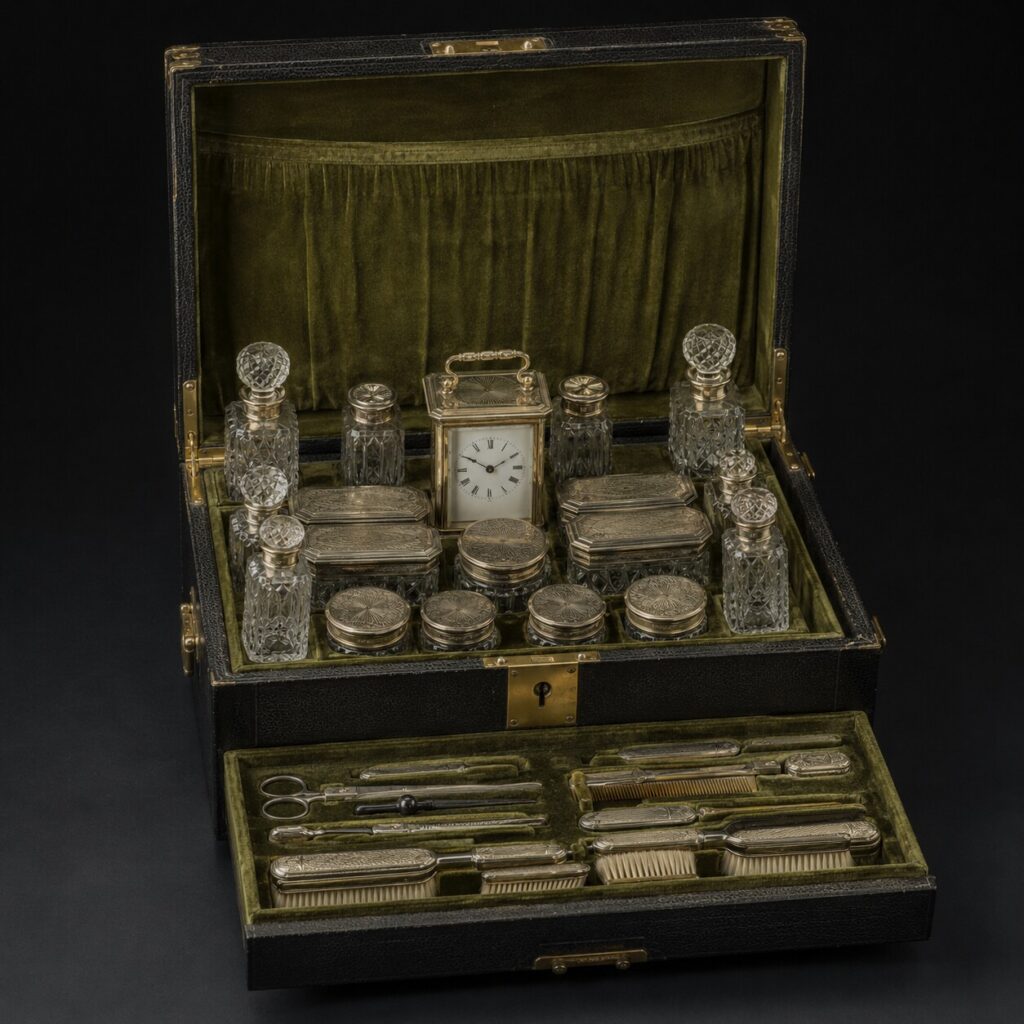
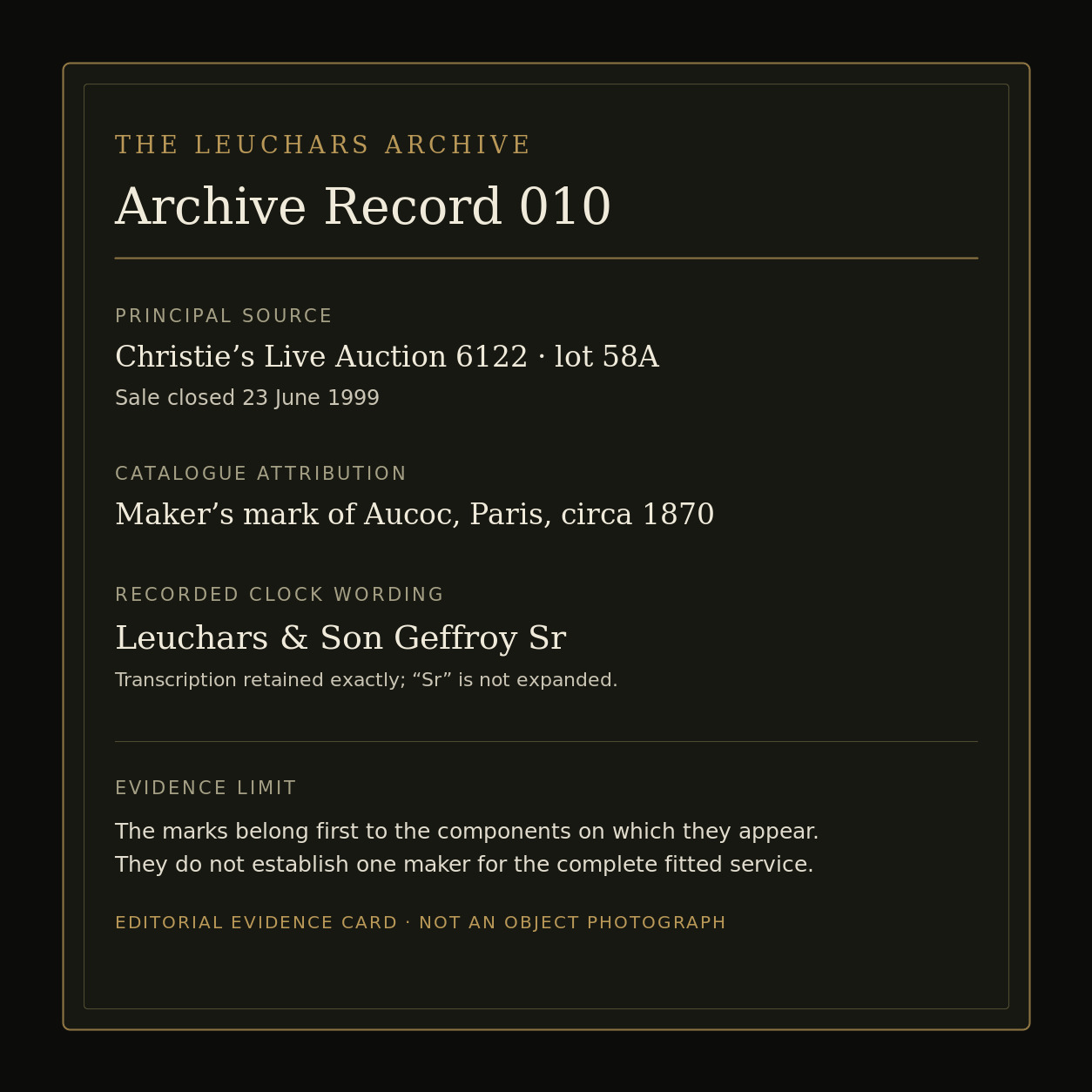
Evidence note: This record is based principally on Christie’s Live Auction 6122, lot 58A. The auction catalogue describes a French silver travelling toilet service with Aucoc maker’s marks on its covers and a carriage clock inscribed Leuchars & Son Geffroy Sr. Those marks establish recorded associations with different names and components; they do not prove that any one firm designed or manufactured the complete service. Christie’s dates the lot to circa 1870, but the wording of the clock inscription requires further chronological control and is not used here to assign an exact date to every component.
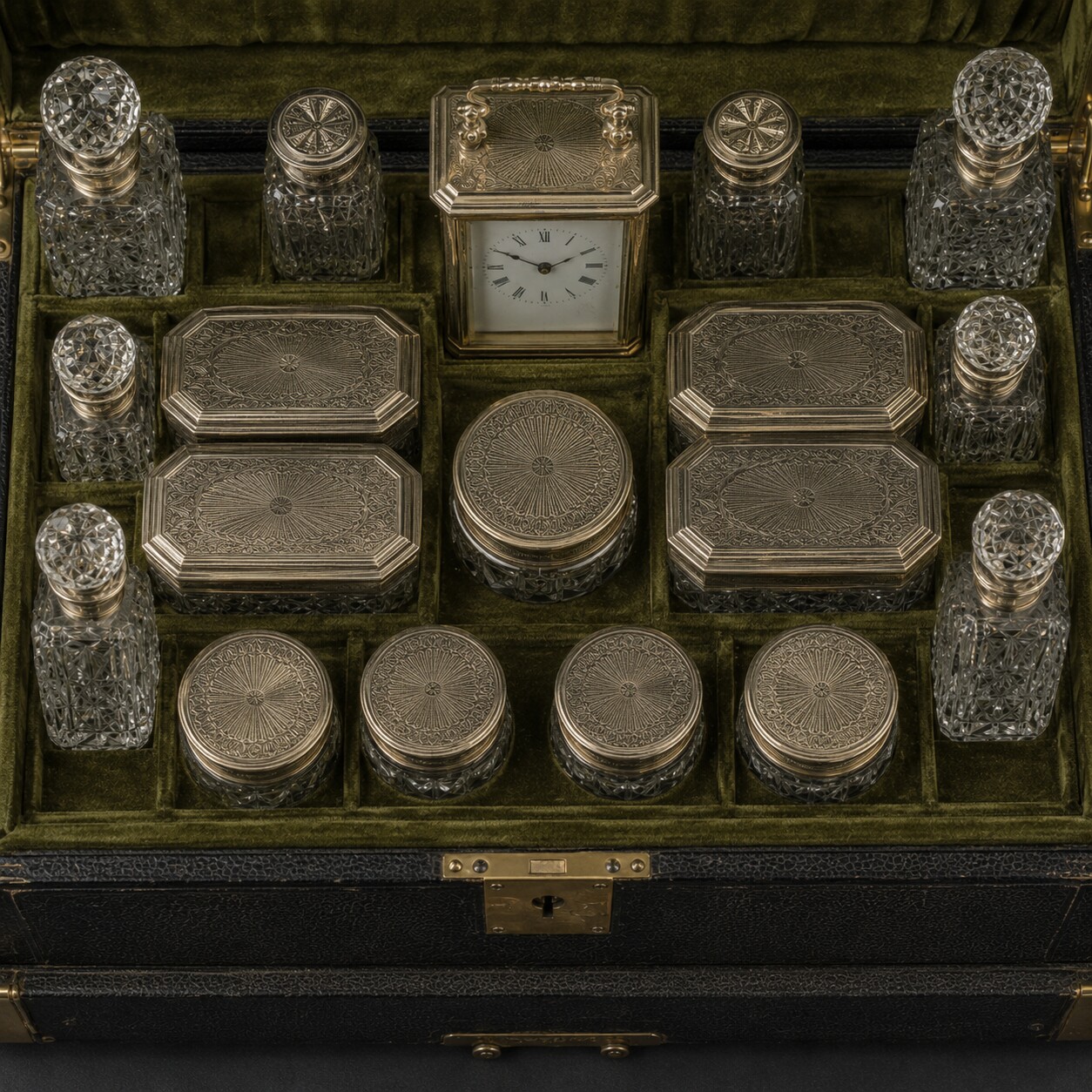
Image note: No Christie’s lot photography is reproduced. The object views prepared for this record are present-day editorial reconstructions based on the written catalogue description, not documentary photographs of the surviving service. They derive from one canonical master and contain no invented legible marks or inscriptions.
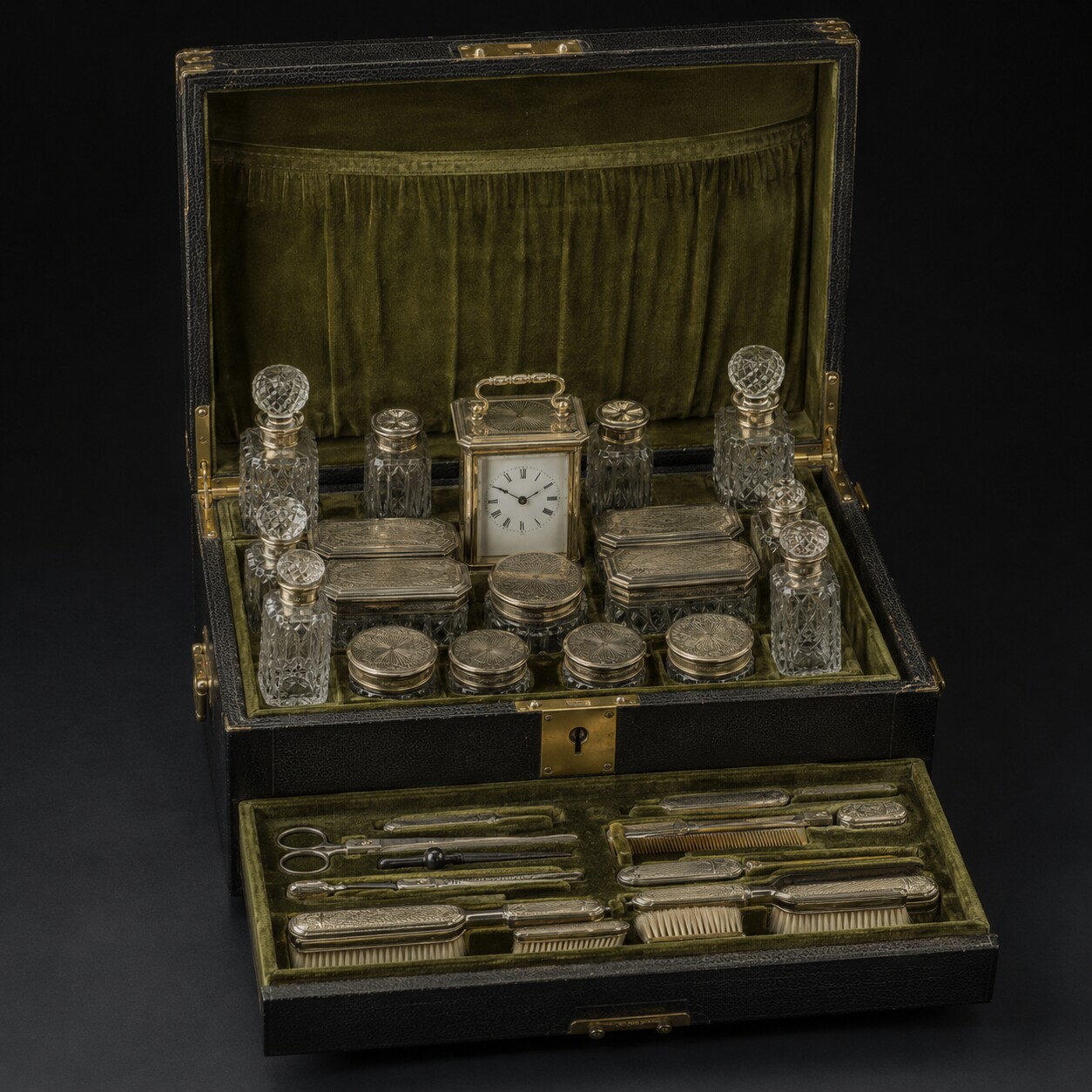
Christie’s records a travelling toilet service whose fitted interior brings together silver, glass, leather, steel, ivory, velvet, a clock and writing implements. Its abundance is striking, but its greater value for The Leuchars Archive lies in the names carried by different parts.
The silver covers bear Aucoc maker’s marks. The travelling carriage clock has a gilt chapter transcribed as Leuchars & Son Geffroy Sr. The service therefore resists a simple sentence of authorship. It is better understood as a coordinated object in which manufacture, component supply, fitting and retail presentation may have belonged to different hands.
A fitted system rather than a list
The catalogue describes seven glass bottles, four oblong boxes and six circular boxes. Their silver covers have reeded borders, applied foliage, engine-turned centres and a three-crescent badge. A similarly mounted carriage clock sits within the same visual scheme.
Beneath the upper arrangement, trays lift to reveal ten leather boxes with metal mounts and seventeen ivory and steel instruments. Further implements are secured inside the cover, alongside a blotter, paper knife, mirror and comb. The whole is contained within a green velvet-lined leather case.
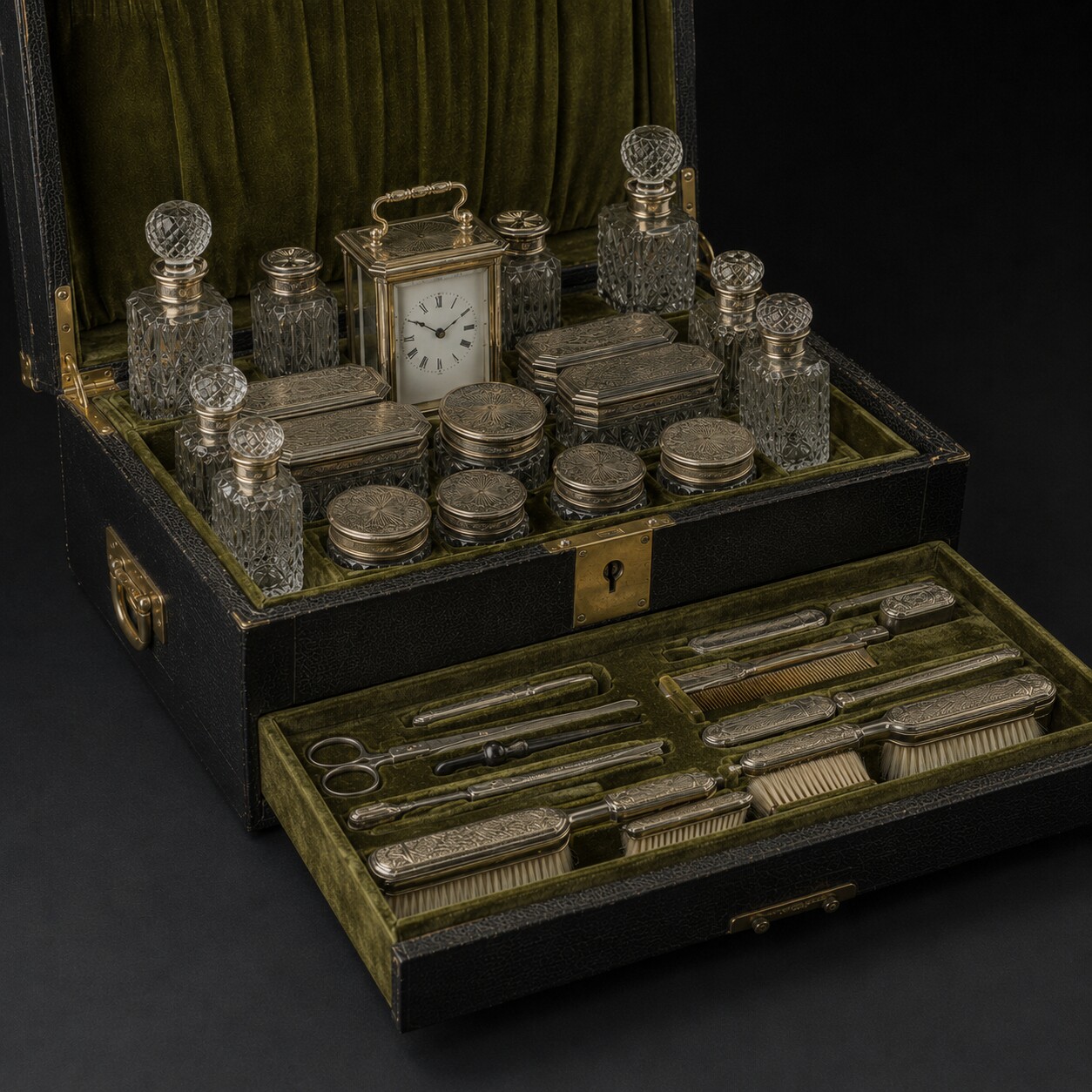
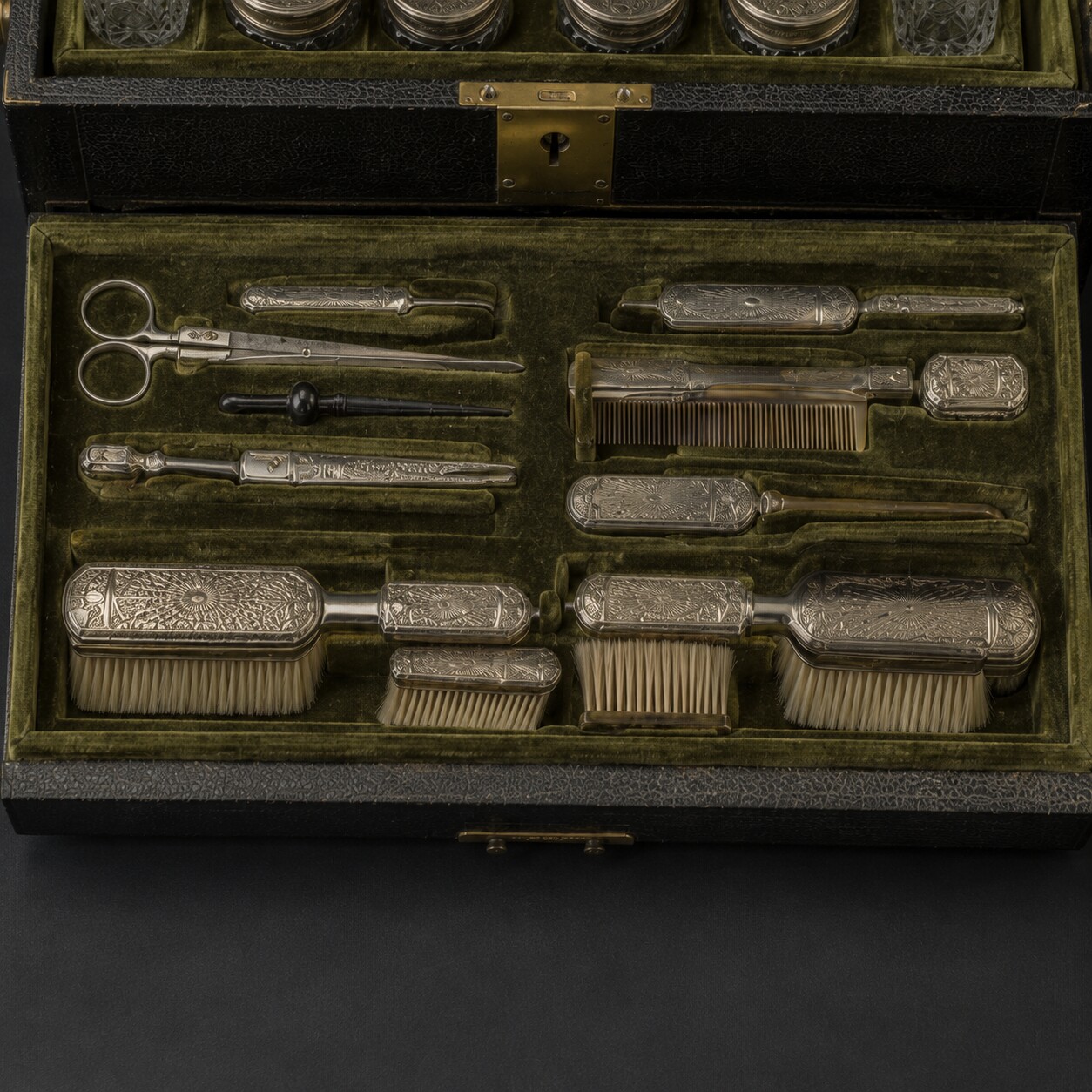
This arrangement is not simply accumulation. Bottles, boxes, instruments, grooming pieces, writing tools and timekeeping are organised into a portable interior. The case gives each object a place and turns many specialist components into one usable travelling system.
What the Aucoc mark establishes
Christie’s catalogues the lot under the maker’s mark of Aucoc, Paris. That attribution provides important evidence for the marked silver covers. It should not be stretched beyond the marks actually described.
The public record does not state that Aucoc made the leather case, the glass bodies, the clock movement, the steel instruments or every fitted tray. Comparable museum records show why this caution matters: National Museums Scotland distinguishes a named maker from Aucoc Aîné’s retail role within another travelling toilet set.
The comparison does not solve lot 58A. It does establish the correct research method. Every mark belongs first to the component on which it appears.
The Leuchars-Geffroy clock
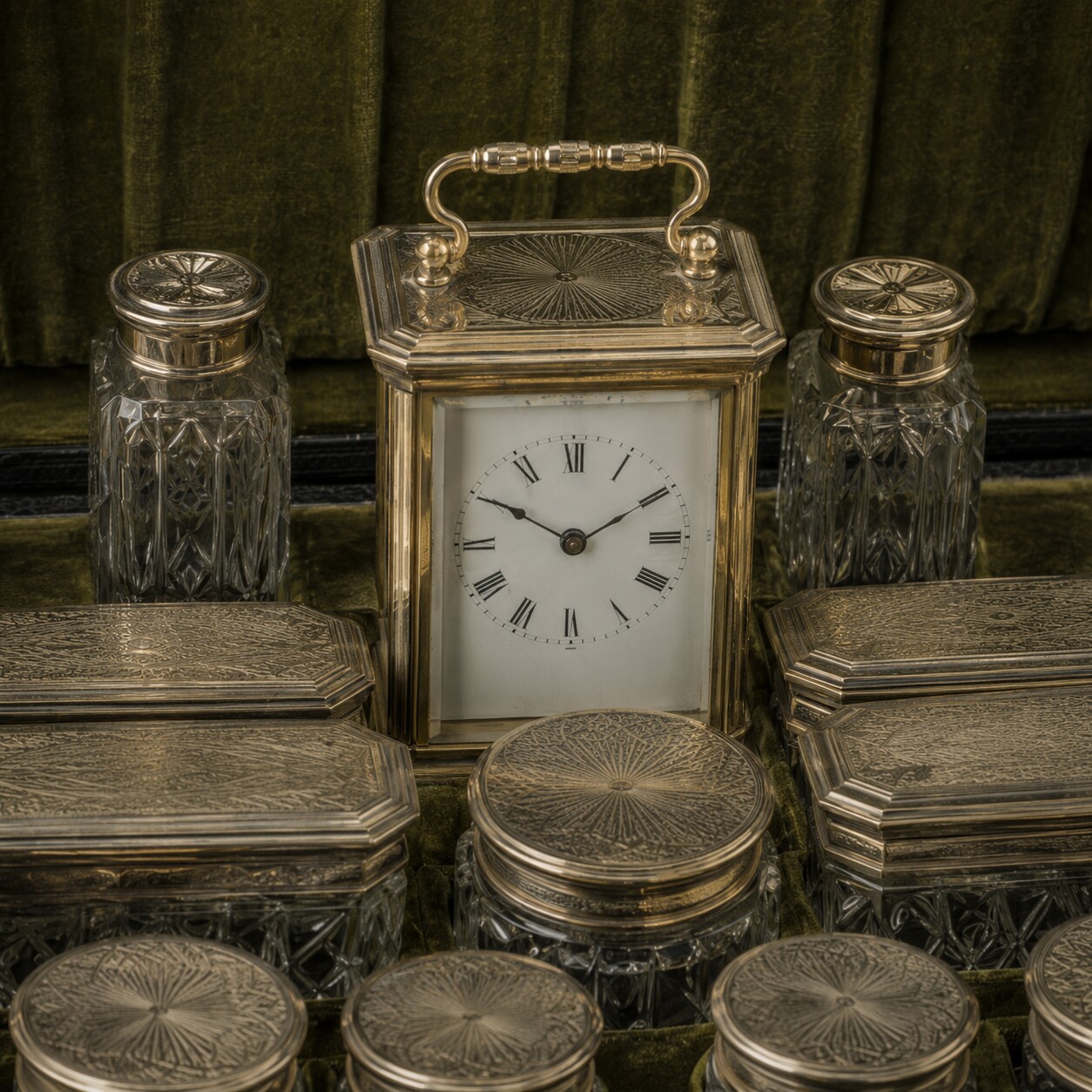
The carriage clock introduces a second commercial identity. Christie’s transcribes its gilt chapter as Leuchars & Son Geffroy Sr. The inscription joins the clock visually to the service while complicating the question of authorship.
It may record a retailer, supplier, successor-era identity or another commercial relationship. Without a legible close view, movement signature, invoice or contemporary catalogue, the Archive does not choose among those possibilities. It also leaves Sr unexpanded.
The clock is therefore evidence of association, not a licence to call the complete service a Leuchars manufacture.
A date that must remain controlled
Christie’s assigns the lot to circa 1870. That remains a useful auction-house attribution, but it is not yet a fully reconciled date for the assembled service. The Leuchars-Geffroy formula recorded on the clock appears on comparative objects placed later in the nineteenth or early twentieth century.
Several explanations remain possible. The auction date may be broad. The clock may be later than some of the silver. The service may have been altered, refitted or assembled over time. The transcription may conceal a distinction visible only in the original mark.
None of those possibilities is yet proven. The Archive therefore records the tension instead of resolving it by assumption.
The useful lesson of divided authorship
Luxury fitted objects often depended on coordination across trades. Silversmiths, glass makers, clockmakers, leather workers, instrument makers, case fitters and retailers could contribute to one coherent object. The quality of the finished service lay partly in making those different elements function as a whole.
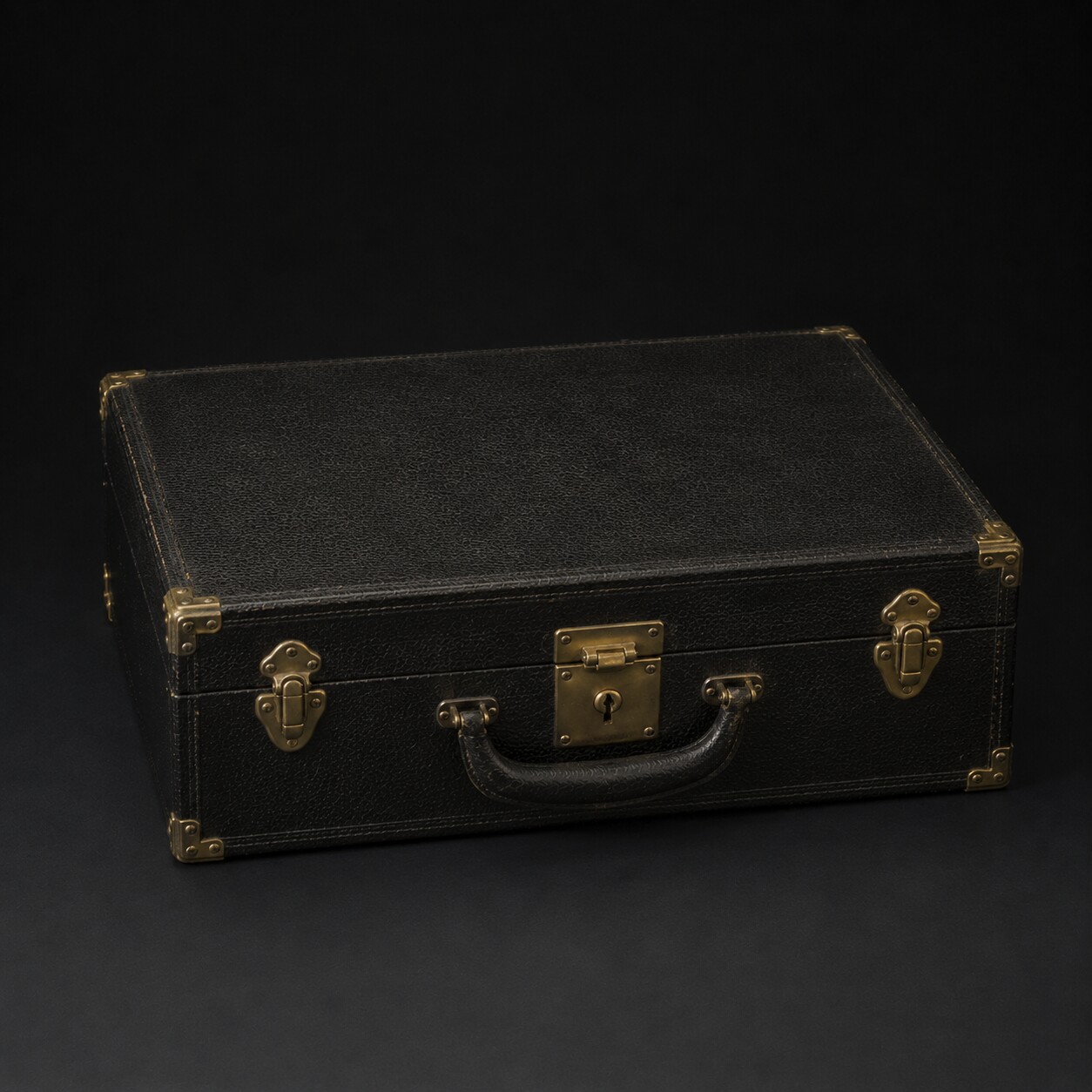
That is the lasting relevance of lot 58A. It expands the history associated with the Leuchars name without requiring an unsupported claim that Leuchars made everything within the case. It also offers the present-day house a clear discipline: provenance begins by distinguishing roles, and design authority is strongest when complexity is recorded rather than concealed.
Sources
- Christie’s, Live Auction 6122, lot 58A, A French silver travelling toilet service.
- National Museums Scotland, travelling toilet-set component associated with Aucoc Aîné and Jules Coquelin.
- The Metropolitan Museum of Art, case 61.78.1–.50 and hand mirror 61.78.50.
- Christie’s, A leather briefcase by Leuchars and Son, lot 5407734.
- Christopher Clarke Antiques, Cased Tea Set by Leuchars, reference 82798.
